Developing next-generation superconducting magnets
Fermilab’s R&D spans advanced superconducting materials, magnet prototypes, diagnostics and analysis tools. From novel conductors and HTS coils to AI-driven monitoring and quench studies, the sections below highlight current innovations driving next-generation accelerator magnets.
Conductors | HTS magnet models | Magnetic measurement probes | Quench antennas | AI and machine learning methods | Vibrational methods | Experiments with QCD
Conductors
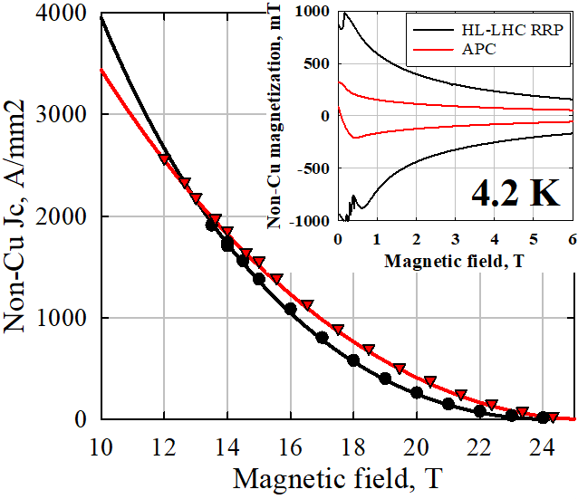
Fermilab, in collaboration with industry, is developing a new type of Nb₃Sn superconductor featuring artificial pinning centers. These APC conductors can achieve higher critical current density (Jc) in high magnetic fields (e.g., 14-18 T), enabling the construction of more compact and cost-effective dipole magnets. They also exhibit much lower persistent-current magnetization than present commercial Nb₃Sn conductors, which helps reduce field errors and AC losses in magnets.
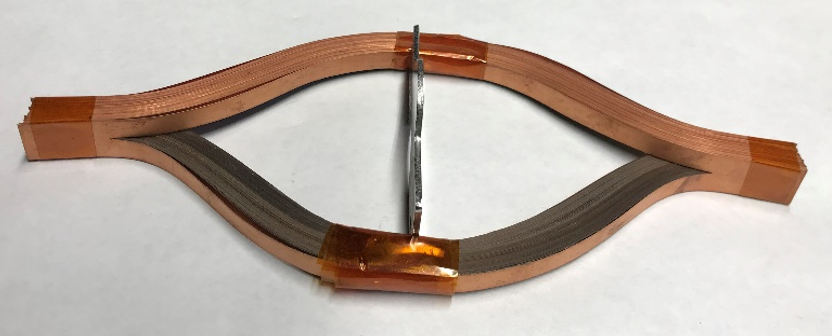
In addition, Fermilab is developing a new architecture of ReBCO tape and new designs of ReBCO cables in order to enhance performance. Flexible, flat ReBCO cables, such as the prototypes shown on the right, could eventually replace traditional Rutherford cables used in NbTi and Nb₃Sn magnets, and will allow reaching considerably higher magnetic fields and/or operation at intermediate temperatures (e.g., liquid hydrogen).


HTS magnet models
The Conductor on Molded Barrel (COMB®) magnet technology is being developed at Fermilab’s Magnet Technology Division, specifically for applications with round REBCO conductors. This technology addresses the growing demand from the physics community for higher magnetic field strengths, which lead to high levels of mechanical stresses in the coils and degradation of conductor properties. Fermilab investigated a novel approach to fabricating HTS coils fabrication – assembling them from parallel HTS loops without splices.
In this design, HTS tape is stacked rather than wound into a multi-turn coil. The persistent current in the coil is generated by magnetic flux change from the primary source. In addition, Fermilab is also developing HTS dipoles with mechanical energy transfer in a magnetic field. Iron-dominated superconducting quadrupole and dipoles were used as a test bench for HTS coils.
Magnetic measurement probes
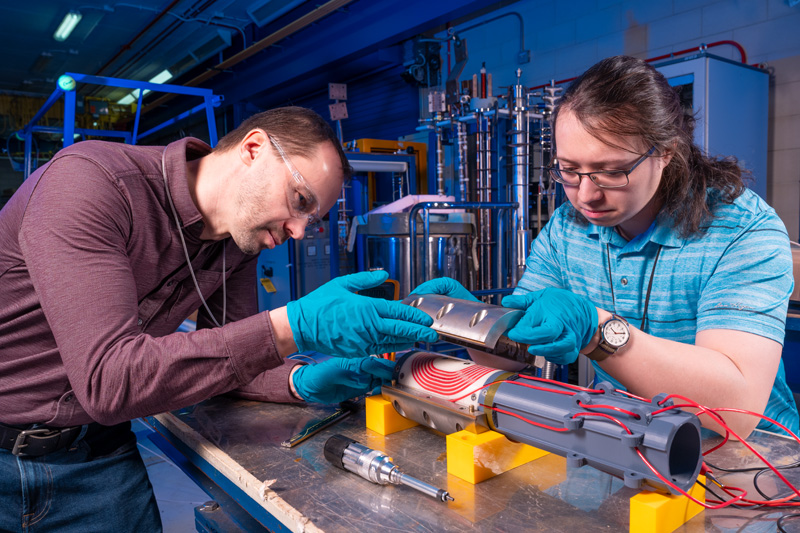
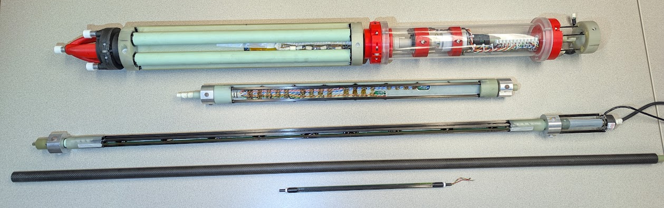
Magnetic field measurements, which determine the as-built strength, field uniformity and alignment parameters, are used in qualifying magnets for accelerator operation and for understanding and simulating expected beam behavior. To achieve parts-per-milllion precision in field quality measurements within magnet apertures, Fermilab has developed a wide range of inductive voltage rotating coil probes.
The variety of lengths and diameters is indication of the diversity of magnets and the efficacy of the technique. The probes feature multiple windings, typically manufactured with Printed Circuit Board (PCB) technology for high accuracy. The different windings allow for measurement of the main field, but also include some that suppress this fundamental field (and thus the effects of vibrations during rotation), in order to yield high accuracy/resolution results of residual multipole harmonics that impact field quality.
Quench antennas
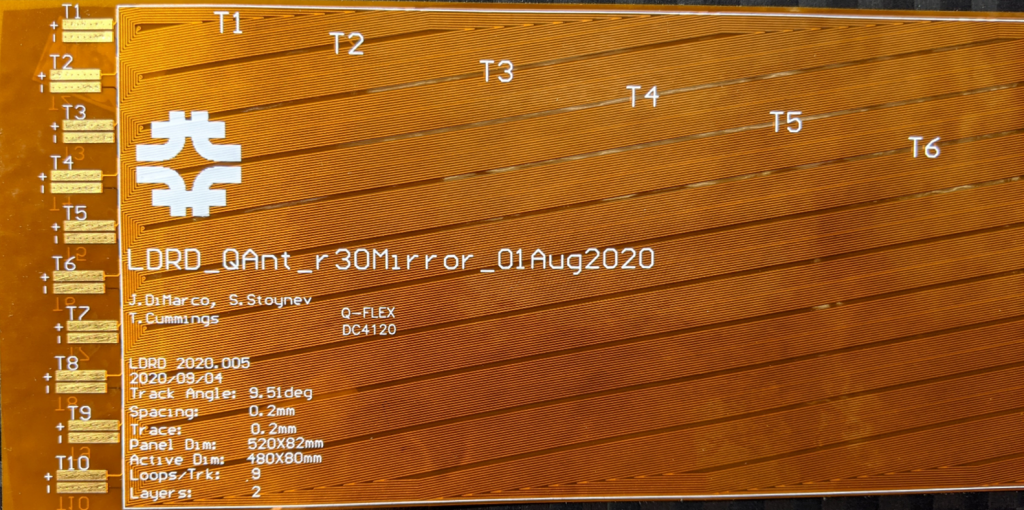
Quench antennas are inductive, stationary pickup loops to detect magnetic transients such as those which occur when a section of superconducting cable suddenly becomes resistive. The superconducting state being extinguished is known as a quench, and occurs rapidly, as the quench generates heat, which further propagates and accelerates the quenching region.
QAs can be designed in various ways to be optimized for specific purposes and geometries. To improve noise immunity, active regions can be arranged in opposition, a technique known as bucking. In general, there is a trade-off between having a fine localization, minimizing number of data acquisition channels, and maximizing signal size. Some QAs can be introduced between magnet layers during fabrication or be arranged in intersecting arrays. Fermilab is also developing QAs that take advantage of magnetic measurements to localize quenches based on harmonic analysis.
AI and machine learning methods
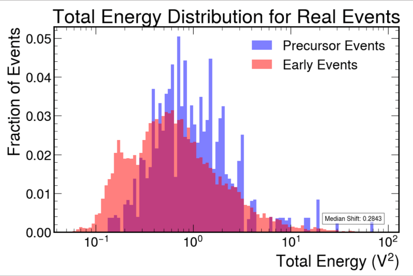
With the rise of AI and machine learning technology, the R&D group is developing advanced, intelligent systems to monitor, predict and prevent superconducting magnet quenches in magnet systems. This effort focuses on automating data processing, selection and curation to develop and train ML models for more robust quench detection across SC magnet facilities.
This initiative has evolved alongside advancements in AI-driven modeling and high-speed instrumentation, aiming to provide real-time, predictive protection for high-field Nb₃Sn and emerging HTS magnet systems. The program builds on decades of operational data, leveraging modern ML techniques to enhance quench onset prediction, reduce false triggers, and improve overall system uptime and safety.
Vibrational methods
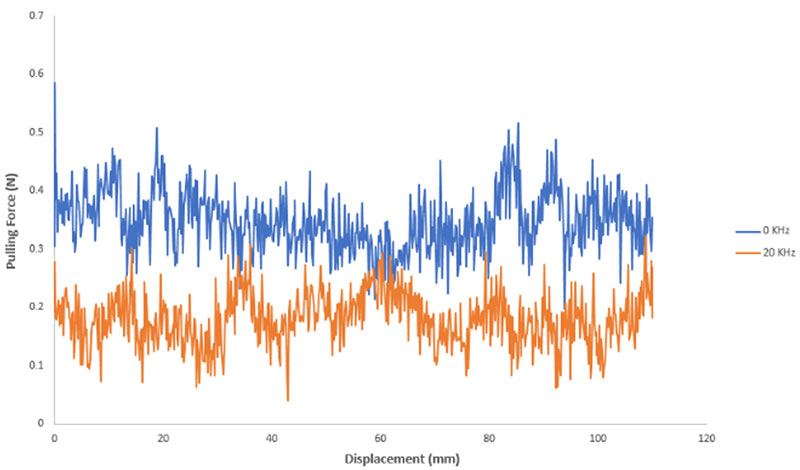
Fermilab is investigating methods to reduce the friction coefficient in magnet interfaces by applying ultrasonic vibrations. This work focuses on understanding key friction parameters in superconducting magnets, given their critical role in magnet training events. The team conducted multiple small experiments on static and dynamic frictional force of contact surfaces to validate reproducibility of experiment.
Demonstration of a notable reduction in friction coefficient when 20 kilohertz of vibration, at 50 watts, was applied on test surface interfaces. While this behavior is well known elsewhere, the near-term objectives involve delving into the reduction of friction in cryogenic environments and representative magnet interfaces.
Experiments with QCD
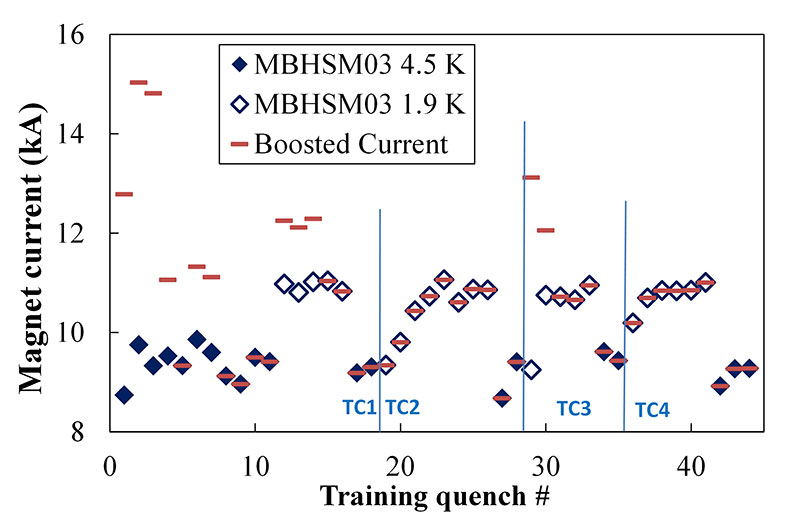
The quench current-boosting device, is a capacitor-based device developed at Fermilab for quench investigation. It provides a fast current boost to a magnet, enabling studies of quench characteristics and underlying mechanisms. Key research questions addressed include:
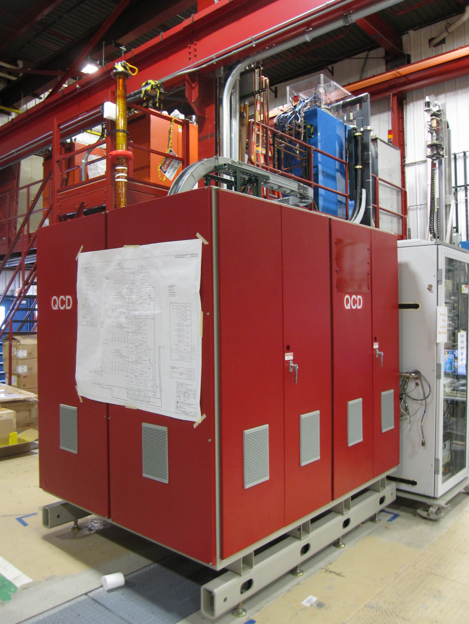
- What is the minimum time required for high current or force to affect the mechanical state of a superconducting accelerator magnet (“magnet training”)?
- What insights can be gained about force distribution and evolution at scale relevant for magnet performance?
- Is a magnet “preconditioning” an efficient way to prepare a superconducting magnet for operations?
Those are some of the driving questions that could be answered by utilizing QCD.