
This page describes the APS-TD contribution to PIP-II. For more information, visit the PIP-II website.
The Proton Improvement Plan-II is an essential enhancement to the Fermilab accelerator complex, powering the world’s most intense high-energy neutrino beam on its journey from Illinois to the Deep Underground Neutrino Experiment in South Dakota – a distance of 1,300 kilometers (800 miles). DUNE scientists will use neutrinos to answer some of the most profound questions about the universe.
Fermilab engineers have developed technology for the heart of PIP-II, an 800 million electron volts superconducting linear accelerator, capitalizing on APS-TD expertise in superconducting radio-frequency cavities and superconducting magnets. Once completed, the superconducting linac will be the starting point for the megawatt proton beam needed for the Long-Baseline Neutrino Facility.
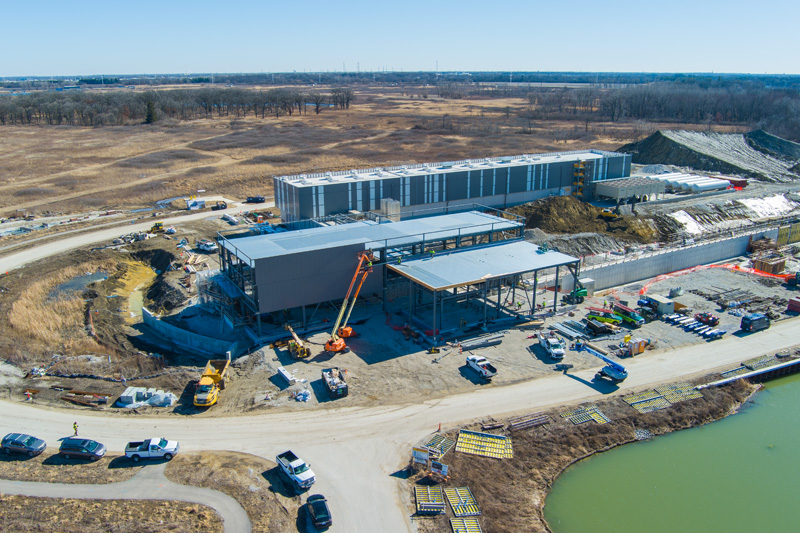
Building the superconducting linac for PIP-II
The superconducting linac for PIP-II is uniquely challenging because of its operating requirements. In early implementation, the cryomodules that accelerate the beam will run in continuous mode. Eventually, they will be capable of operating in pulsed mode, saving on operational costs by significantly reducing power requirements. In pulsed operation, the cavity’s mechanical design must be optimized to reduce Lorentz force detuning, a shift in the cavity frequency caused by a changes in the electromagnetic field. Real-time control algorithms will then compensate for any remaining detuning.
Under continuous-wave operation, the cavity’s mechanical design must be optimized to reduce the effects of microphonics, which are changes in the cavity frequency caused by helium pressure fluctuations and external vibrations. APS-TD successfully conducted extensive engineering, prototyping, and testing to make both spoke-type and elliptical superconducting radio-frequency cavities effective in both operating modes.
Development of cryomodules
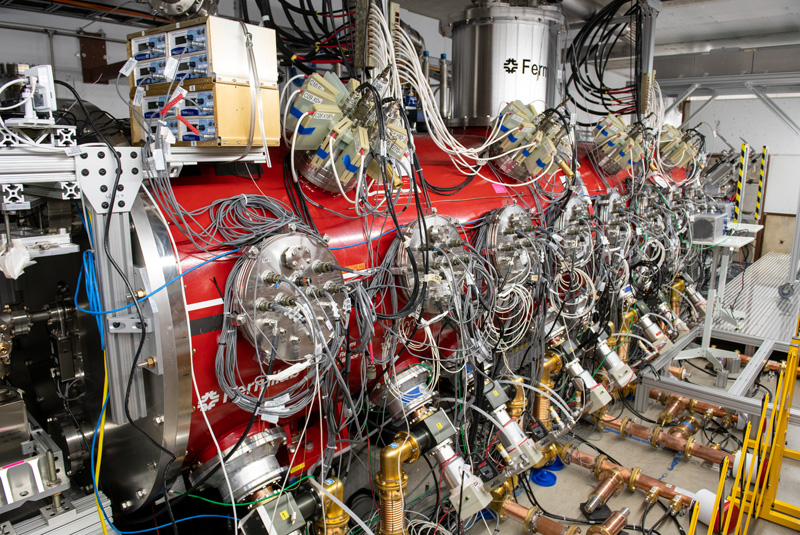
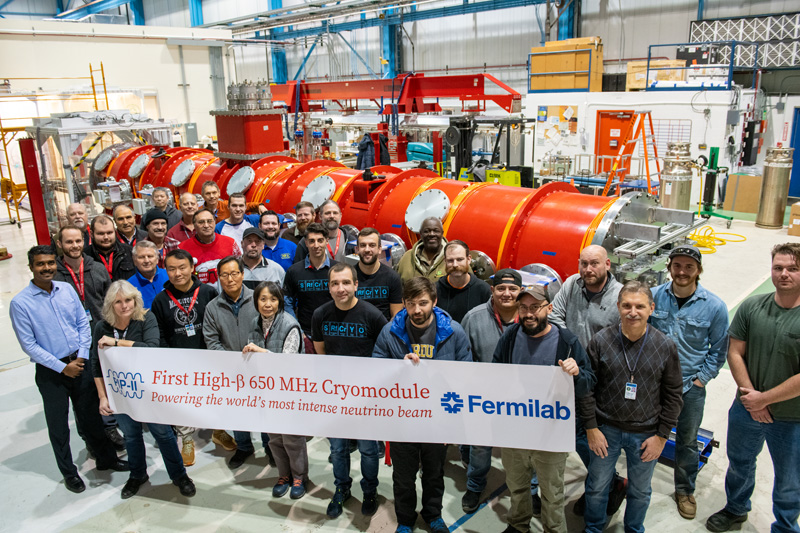
Fermilab has developed cryomodules to house the superconducting cavities needed for the PIP-II linac. A completed cryomodule contains the SRF cavities and beam focusing magnets, thermal and magnetic shields, cryogenic piping, insulation, cavity support and alignment system, controls and instrumentation. While the design incorporates features from similar cryomodules at DESY, Jefferson Lab, SNS, and other international laboratories, the overall design is a unique creation of the APS-TD Cryomodule Engineering team and unlike any other in the world.
Cryomodule and magnet innovation for PIP-II
PIP-II cryomodules feature a unique design where each unit is sealed at both ends, with only the beam tube connecting adjacent modules. This modular approach allows individual cryomodules to be replaced without impacting the rest of the linac. Each cryomodule has its own connections to a shared transfer line and an independent 2 kelvin heat exchanger, eliminating the need for a large common gas return like those used in XFEL or LCLS-II.
Instead of using a cold support system, PIP-II cryomodules use a room-temperature strongback located outside the thermal shield. All cavities and magnets are mounted to this stable structure with composite support posts, helping to maintain precise alignment during cooldown and operation, which is critical for high-performance beam transport.
Progress on cryomodule prototypes and production
APS-TD has completed and tested prototype cryomodules for the SSR1 and HB650 systems, and a pre-production SSR2 unit is underway. In parallel, Fermilab’s partner CEA in France is building a pre-production LB650 module. With designs finalized, full-scale production and procurement are moving forward.
Beamline magnet design and testing
In addition to cryomodules, APS-TD leads the development of beamline magnets essential to PIP-II’s operation. These include dipoles, quadrupoles, and solenoids, built with conventional and superconducting technologies. Developed with domestic and international partners, the magnets are integrated into larger assemblies or installed as standalone elements and are rigorously tested on Fermilab’s beamline as part of the PIP-II commissioning process.
Leveraging worldwide expertise
Fermilab and DOE have engaged partners worldwide to help make PIP-II a reality, using the expertise of institutions in the U.K., France, Italy and India. These institutions have agreed to provide completed cryomodules, cryomodule components, and a commercial cryoplant for PIP-II as in-kind contributions.
- CEA in France will assemble and test all of the 10 low-beta cryomodules
- UKRI will assemble three high-beta cryomodules
- INFN in Italy will provide 40 low-beta qualified cavities
- CNRS in France will test all 33, SSR2 production cavities
- India’s Department of Atomic Energy (DAE) will provide cryomodule components
These in-kind contributions enable the PIP-II superconducting linac to be built at a lower cost and faster timeline, by leveraging the expertise of other leading SRF laboratories.
Single largest in-kind contribution to PIP-II
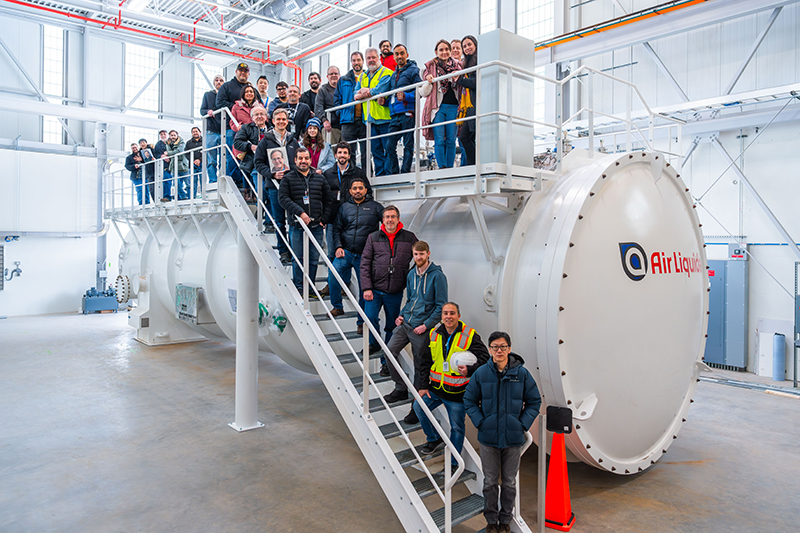
A major in-kind contribution from India’s DAE and Bhabha Atomic Research Centre is the commercial cryogenic plant, the largest single in-kind contribution to PIP-II. The APS-TD Cryogenic Technology Division played a critical role in designing, procuring, fabricating and installing the cryogenic system that supports the plant. This large and complex effort involved engineering design, drafting, procurement coordination, and highly skilled technical staff across the division. Close collaboration with India’s DAE was essential to ensure technical alignment and manage logistical and contractual challenges. This partnership reflects the scale and importance of international collaboration on the PIP-II project.