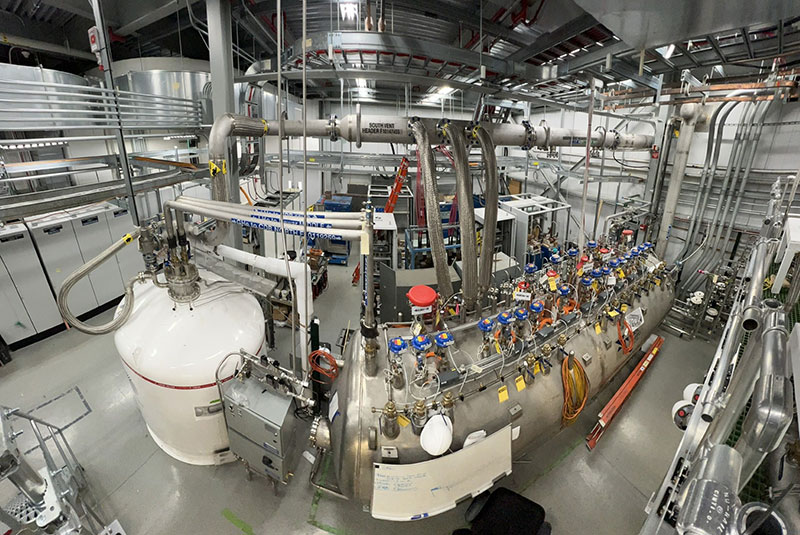
This page describes the APS-TD contribution to Mu2e. For more information, visit the Mu2e website.
Mu2e is a groundbreaking experiment at Fermilab designed to search for a rare process called muon-to-electron conversion, which the Standard Model does not predict.
By studying this potential violation of charged lepton flavor, Mu2e aims to uncover signs of new physics. Using a powerful proton beam, advanced detectors and a unique solenoid system, the experiment will improve sensitivity by 10,000 times over previous efforts. Observing muon-to-electron conversion would be a major breakthrough and could reveal the existence of new particles or forces.
To carry out this search, Mu2e relies entirely on magnetic fields to guide and control particles. It takes three massive, precisely engineered superconducting solenoids to create the magnetic environment necessary for the experiment. Each of these magnets must produce powerful, stable fields with strict performance specifications. This critical piece of the experiment is engineered and delivered by APS-TD.
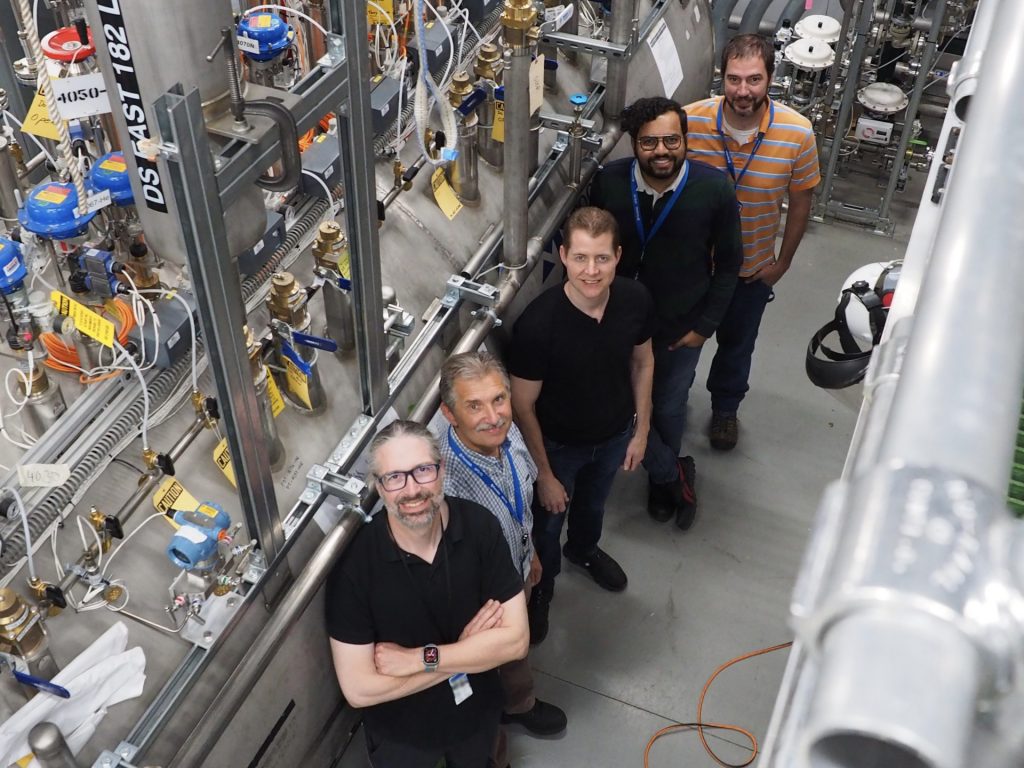
Solenoids and superconductivity
At the heart of Mu2e are solenoid magnets, which are coils of wire wrapped around a hollow tube. When electrical current flows through the coils, a magnetic field forms along the axis of the tube. Charged particles like muons and electrons spiral along this field in corkscrew-like paths, a behavior that lets scientists direct particles exactly where they need them.
Mu2e pushes this concept further by using superconducting solenoids. Superconductors are special materials that, when cooled to temperatures near absolute zero, lose all electrical resistance. This allows extremely high currents to pass through the coils without generating heat, resulting in the strong magnetic fields Mu2e requires. These fields are crucial for filtering out unwanted particles and focusing the ones that matter.
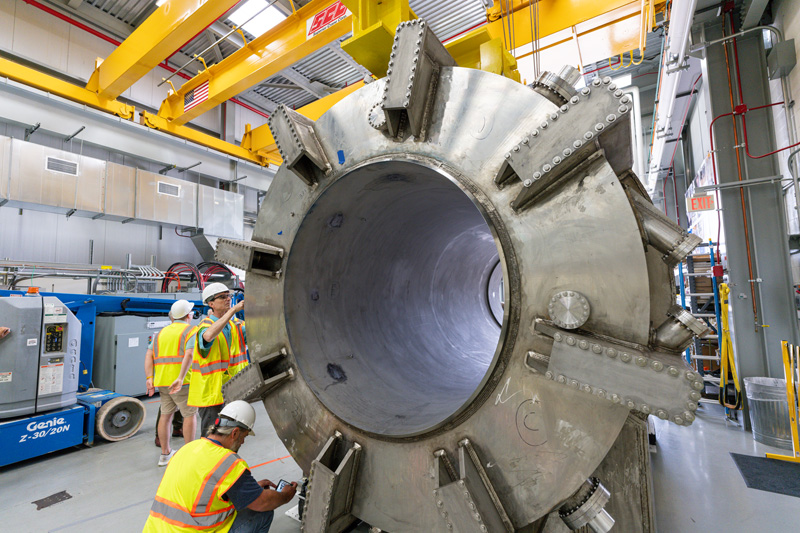
The APS-TD team is responsible for the design and procurement of all three superconducting solenoids each tailored to perform a specific function in the experiment.
Delivering cryogenics for superconducting performance
Beyond magnets, APS-TD’s Cryogenic Technology Division is deeply involved in making the Mu2e experiment function. Superconducting magnets must be kept at cryogenic temperatures, and APS-TD supports the design, fabrication, installation and operation of the Mu2e cryogenic system. This includes the use of repurposed Tevatron Mycom helium compressors and satellite refrigerators to maintain the ultra-cold environment necessary for superconductivity.
Collaborative engineering
APS-TD also led the acquisition and integration of one of the largest helium purifiers in the world, installed at the MC-1 facility, to help ensure long-term operational stability.
In addition, the cryogenic distribution system inside the Mu2e experimental hall was designed and integrated by APS-TD engineers. This work represents a major collaboration across Fermilab divisions, with APS-TD working closely with technical staff in the Particle Physics Division to bring the entire system to life.