
Fermilab’s Superconducting Magnets and Materials is a thrust of the lab’s General Accelerator R&D, or GARD, program. Also known as the High Field Magnet Program, it focuses on developing advanced superconducting magnets, materials and baseline technologies for particle accelerators. The program began in 1998, drawing on years of experience with accelerator magnet research and development based on traditional niobium-titanium, or NbTi, superconductor technology used in the Tevatron, SSC and LHC. Since 2016, it has been a key component of the DOE’s National Magnet Development Program.
The HFM program’s strategic goal is to develop a new generation of superconducting accelerator magnets and materials that can achieve LHC operation fields above eight tesla at liquid helium temperatures and offer higher operational margins.
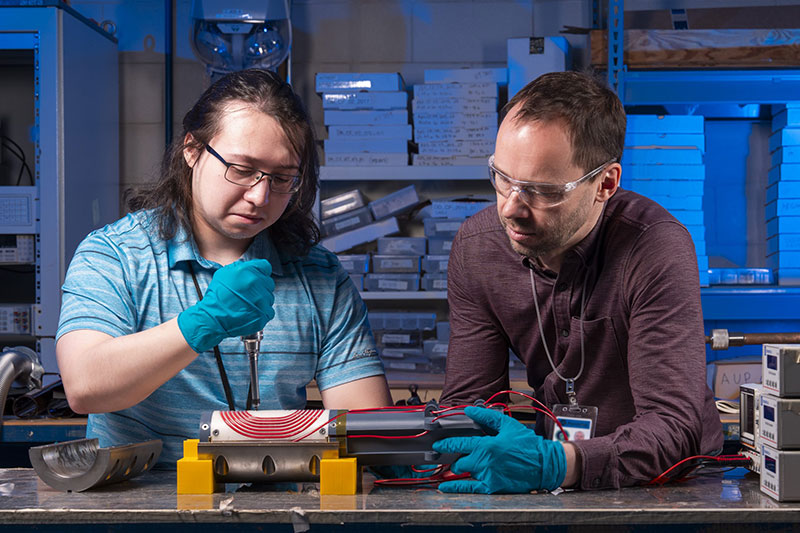
Advancements in Nb3Sn superconducting magnets
HFM program to date
During the past decade, the HFM program has been developing accelerator magnets based on the Nb3Sn superconductor. These magnets can provide operating fields up to 15 to 16 tesla and significantly increase the coil temperature margin. Such magnets are needed for upgrades to the Large Hadron Collider, also called HL-LHC, the Muon Collider Storage Ring (MCSR), and future Very High Energy proton-proton Colliders (VHEppC).
Developments throughout the years
From 2003-2005, the HFM program developed and tested the world’s first series of small-aperture 10-tesla Nb3Sn dipoles for the Very Large Hadron Collider, or VLHC. In 2005, the program shifted its emphasis to large-aperture 11 to 12 tesla quadrupoles for the LHC luminosity upgrade.
From 2011-2015, the HFM program developed and demonstrated, in collaboration with CERN, the feasibility of 11 tesla dipoles for the LHC collimation system upgrade. Since 2015, the program has been redirected to 15 tesla or higher field magnets for VHEppC.
Breakthroughs in magnet technology
Along the way, the HFM program made several breakthroughs in Nb3Sn accelerator magnet technology. Key breakthroughs include:
- The development and demonstration of high-performance Nb3Sn, Nb3Al and Bi-2212 strands and cables
- Reliable and reproducible short and long coil technologies ready for production
- Accelerator-quality dipole and quadrupole mechanical structures and coil pre-load techniques
- The world’s first series of Nb3Sn dipole and quadrupole models with reproducible magnet parameters
- Innovative field-quality correction techniques
These advances make it possible to consider 10 to 12 tesla Nb3Sn magnets in accelerators, specifically for the planned LHC luminosity upgrades.
The role and future of NbTi and Nb3Sn in high field magnets
NbTi and Nb3Sn, both both low temperature superconductors, or LTS, are the two workhorses in the high-field magnet world. The HFM program aims to develop accelerator magnets at the limit of Nb3Sn capabilities.
In the longer term, the program will advance the development of accelerator magnets beyond the limits of Nb3Sn technology, with fields of 20 to 25 tesla based on LTS (Nb3Sn) and high temperature superconductors, or HTS, such as Bi-2212 or ReBCO coils. The HFM program also aims to substantially reduce magnet costs by addressing fundamental aspects of the technologies in use or in development.