The High-Luminosity Large Hadron Collider, or HiLumi LHC, is an ongoing major upgrade for the LHC at CERN. The US-HiLumi LHC represents the United States’ contribution to the HiLumi LHC project. Developed from the U.S. LHC Accelerator Research Program, LARP, US-HiLumi LHC focuses on designing, fabricating and testing new interaction region quadrupoles and new crab cavities. The project involves participation from the following national laboratories:
- Fermi National Accelerator Laboratory
- Brookhaven National Laboratory
- Lawrence Berkeley National Laboratory
This page describes the APS-TD contribution to the US-HiLumi Accelerator Upgrade Project. For more information, visit the High Luminosity LHC Project website.
Interaction region quadrupoles
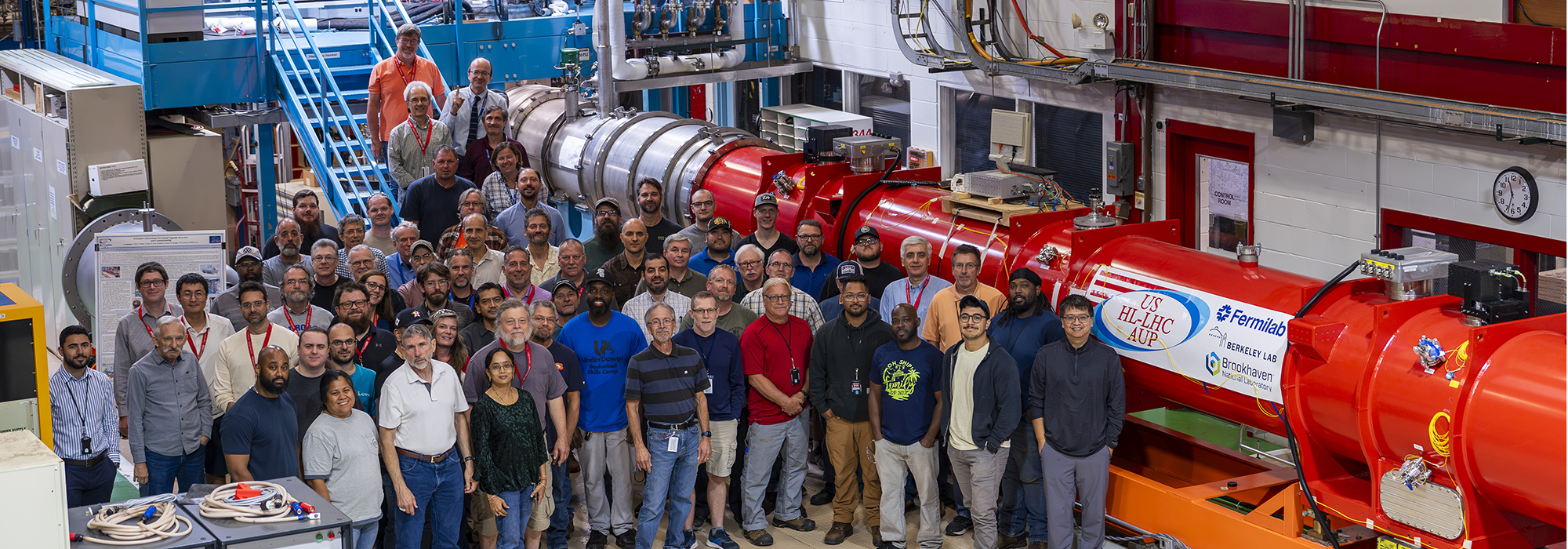
HiLumi LHC relies on large-aperture niobium-tin, or Nb3Sn, quadrupoles for final beam focusing. Over the past decade, LARP has developed quadrupoles with apertures of 90 millimeters, 120 millimeters, and 150 millimeters using the brittle but high-performing superconductor Nb3Sn. These developments were accomplished with the robustness required for successful deployment in the LHC.
APS-TD plays a central role in fabricating HiLumi LHC interaction region quadrupoles. The process begins with coil winding and curing in the Fermilab Industrial Building Complex, where prototype coils are treated with a ceramic binder to ensure stability during handling. Next, the superconducting material undergoes a 640 °C Nb3Sn formation heat treatment followed by epoxy impregnation, both steps performed by APS-TD. Once four coils have been assembled and preloaded into a magnetic flux return structure, the complete magnet is cold tested at APS-TD’s test facility.
Crab cavities
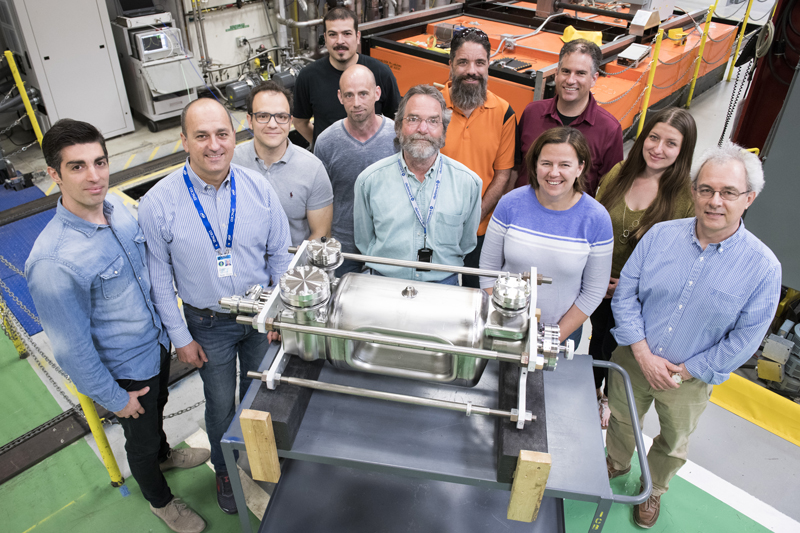
Particle colliders typically have beams crossing at a small angle, reducing particle collisions and luminosity. To increase collisions and luminosity, each beam bunch can be slightly rotated for increased overlap at the collision point. HiLumi LHC aims to achieve this rotation using superconducting radio-frequency crab cavities.
At APS-TD, scientists are developing crab cavities designed to kick the nose and tail of each beam bunch in opposite directions, effectively tilting the bunch and maximizing luminosity gain for HiLumi LHC.