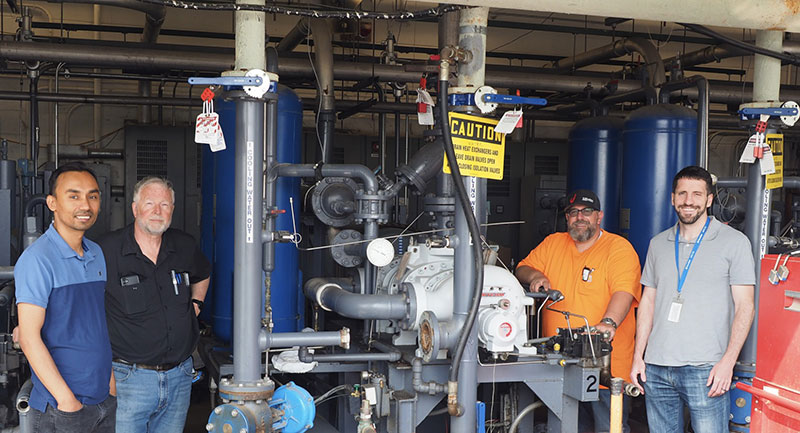
Cryogenic Systems at Fermilab
Cryogenic refrigeration supports nearly every Fermilab project, enabling superconducting systems for major initiatives such as the LHC Hi-Lumi upgrade, SLAC’s LCLS-II, Fermilab’s PIP-II and Mu2e. Millikelvin Cryogenic Systems also support cutting-edge research in Dark Matter Quantum Sensor experiments and Quantum Computing R&D.
Cryomodule Test Facility | New Muon Lab | Industrial Building 1 | Meson Cryogenic Test Facility | Heavy Assembly Building | Muon Campus 1
Cryomodule Test Facility
The Cryomodule Test Facility, or CMTF, is equipped with a cutting-edge cryogenic system designed to support advanced accelerator research and development. The CMTF cryogenic system includes a state-of-the-art superfluid cryogenic plant, or SCP, that supplies helium at 40 kelvins, 5 kelvins and 2 kelvins, with 2-kelvin heat loads up to 500 watts.
Superfluid helium operations at 2 kelvins are achievable through cold or warm compression systems. The SCP can produce about 700 liters per hour of liquid helium at 4.5 kelvins. This cryogenic infrastructure enables ultra-low-temperature testing environments essential for high-performance superconducting components.
The facility supports a variety of critical projects on two test stands, including:
PIP-II Injection Test Stand (PIP2IT): Initially used to support development and testing of the front end for the next-generation PIP-II linear accelerator. It has since been converted into a cryomodule test stand used to commission the PIP-II cryomodules that will complete the PIP-II linac.
Cryomodule Test Stand 1 (CMTS1): Used to test 1.3-gigahertz and 3.9-gigahertz cryomodules for the LCLS-II and LCLS-II HE projects.
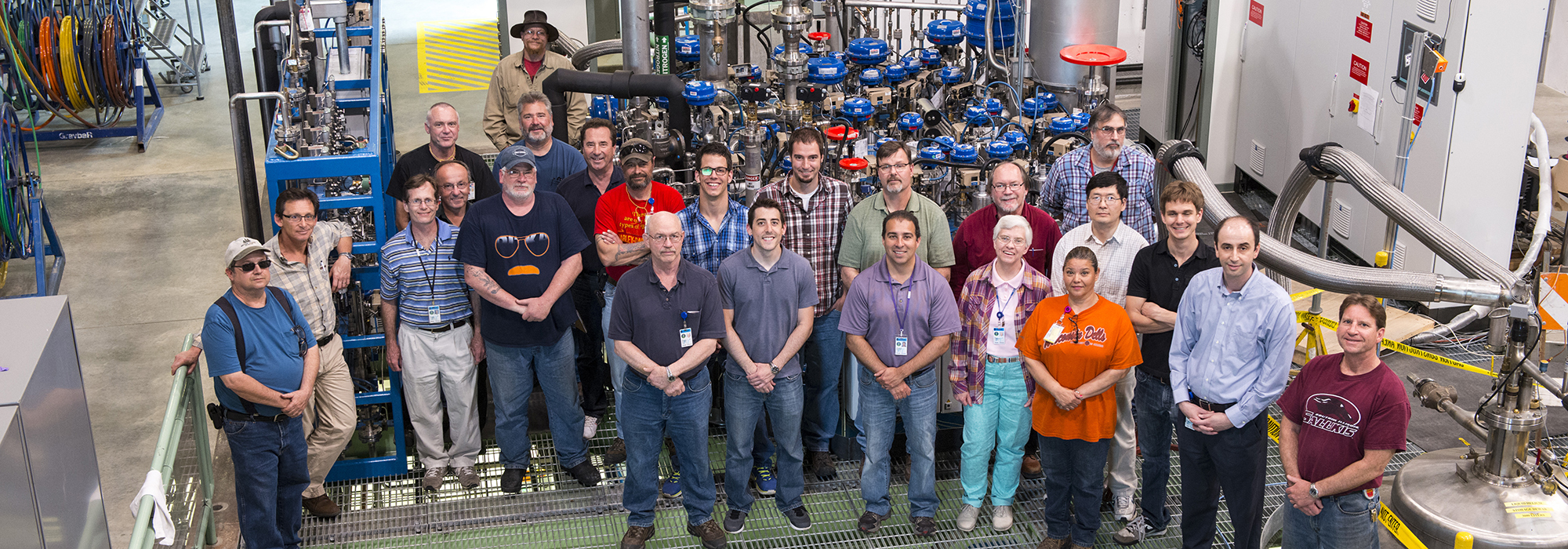
New Muon Lab
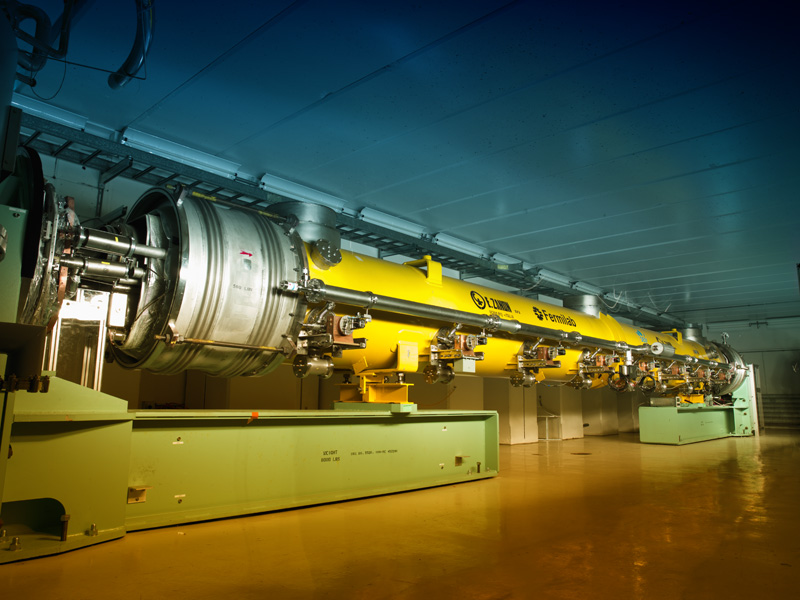
The Fermilab Accelerator Science and Technology, or FAST, facility is located in the New Muon Lab, or NML, building and supports advanced accelerator research enabled by a specialized cryogenic system. The system is designed to maintain the extremely low temperatures required for superconducting technologies.
The NML cryogenic system includes two Tevatron satellite refrigerators capable of a combined liquefaction rate of 125 liters per hour of liquid helium at 4.5 kelvins. A Kinney vacuum pump enables 2-kelvin operations, with a maximum capacity of 60 watts at that temperature.
NML currently provides cooling for a cryomodule and two capture cavities that are integral to the Integrable Optics Test Accelerator, or IOTA. The facility supports research and development using 150-megaelectronvolt electron beams produced by a radio-frequency linear accelerator, advancing next-generation accelerator technologies.
Industrial Building 1
Industrial Building 1, or IB-1, features a versatile cryogenic system that enables testing at extremely low temperatures, essential for a range of advanced accelerator research activities involving SRF cavities and superconducting magnets.
The IB-1 facility includes two large cryogenic plants. One has a CTI 1500 coldbox that provides up to 300 liters per hour of liquid helium. The other is an ALAT Helial LL cryoplant that supplies up to 346 liters per hour. The system also includes four Kinney vacuum pumps that enable 2-kelvin superfluid helium operation, with a combined capacity of about 15 grams per second.
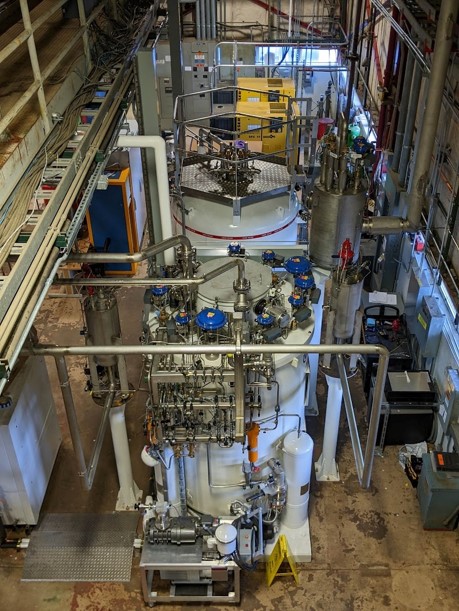
IB-1 currently supports several key facilities and test stands, including:
Test Stand 3: Supports materials testing, magnetic measurements, current lead testing and model verification for R&D projects.
Test Stand 4: Currently being upgraded to support horizontal magnet testing for the High-Luminosity, or Hi-Lumi, project, part of the LHC upgrade at CERN.
Vertical Test Stands (VTS): Three test stands used for SRF cavity research and qualification for projects like LCLS-II and PIP-II, as well as for quantum computing applications.
Vertical Magnet Test Facility (VMTF): Supports research and performance testing of advanced superconducting magnets.
Meson Cryogenic Test Facility
The Meson Cryogenic Test Facility enables precision testing of superconducting components in ultra-cold conditions, supporting the development of next-generation technologies for high-intensity proton and electron accelerators. The facilities include three Tevatron-style satellite refrigerators capable of producing about 1,000 watts of refrigeration at 4.5 kelvins. A Kinney vacuum pump enables 2-kelvin superfluid helium operations to support single-cavity heat loads of 10 to 20 watts.
Currently supported activities include:
Spoke Test Cryostat (STC): Supports integrated testing of single-spoke resonator SRF cavities for PIP-II at 325 megahertz. This test stand was upgraded and is now also used for high-beta and low-beta SRF cavities for PIP-II at 650 megahertz.
Horizontal Test Stand (HTS): Facilitates integrated testing of elliptical SRF cavities with power couplers and tuners, supporting LCLS-II technologies at 1.3 gigahertz and 3.9 gigahertz.
Heavy Assembly Building
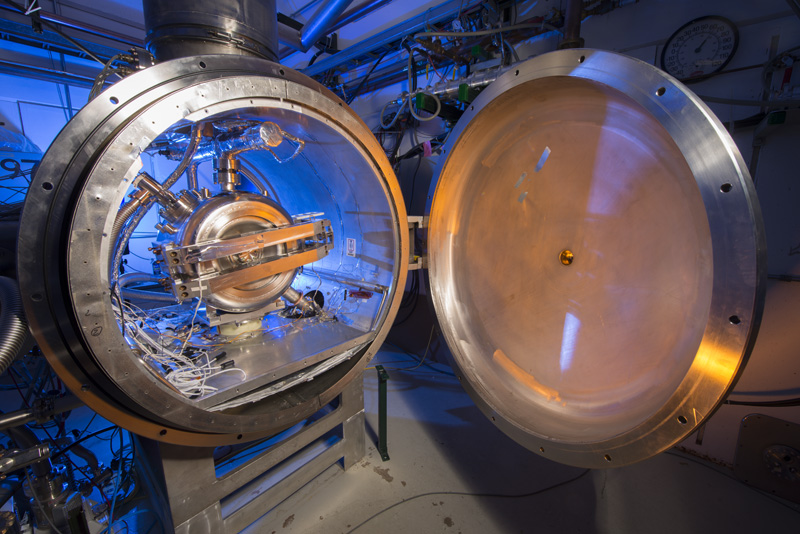
The Heavy Assembly Building provides cryogenic support for testing large superconducting components, using a system originally developed for the Tevatron Collider Detector Facility. This work is essential for ensuring the performance and reliability of key components for one of Fermilab’s flagship experiments in the search for rare muon conversions.
The facility is currently focused on testing superconducting transport solenoids for the upcoming Mu2e experiment at Fermilab’s Muon Campus. The solenoids are mounted and inserted into a specialized cryostat located in the former Collider Detector at Fermilab, or CDF, pit for evaluation under realistic operating conditions.
Muon Campus 1
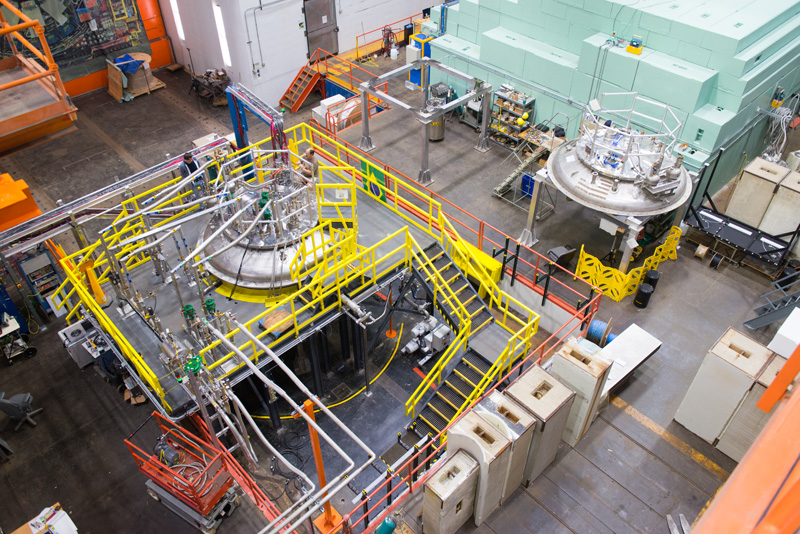
The Muon Campus helium refrigeration system provides essential cryogenic support for key Fermilab experiments. It plays a vital role in advancing particle physics research, including the recent run of the g-2 experiment’s superconducting magnet, originally from Brookhaven National Laboratory, which produced the world’s most precise measurement of the muon magnetic moment. The system also supports the upcoming Mu2e experiment, which is crucial in the search for rare muon-to-electron conversions.
The cryogenic system includes four Mycom compressors at A0 and four refurbished Tevatron satellite refrigerators at MC-1. Each refrigerator can supply 600 watts of cooling at 4.5 kelvins.