The SRF program maintains a diverse portfolio of research directions in superconducting radio frequency and aligns with the needs of the U.S. Department of Energy’s High Energy Physics, Office of Science and the world-wide accelerator community.
The key focus of the research is on dramatically improving cavity performance (quality factor and achievable accelerating gradient), reducing costs and achieving a full understanding of the underlying physics and materials science. The individual research areas are led by expert staff who have received multiple honors, including three DOE Early Career Awards, the Hogil Kim Prize, PAST awards, and various conference poster and presentation prizes.
Research areas
High-Q Nb Cavities | Efficient Meissner Expulsion | Nb3Sn-Coated Cavities | Cavity Resonance Control | Fundamental material investigations | High-Gradient Niobium Cavities | Tunable Cavity R&D
High-Q Nb Cavities
Nitrogen Doping
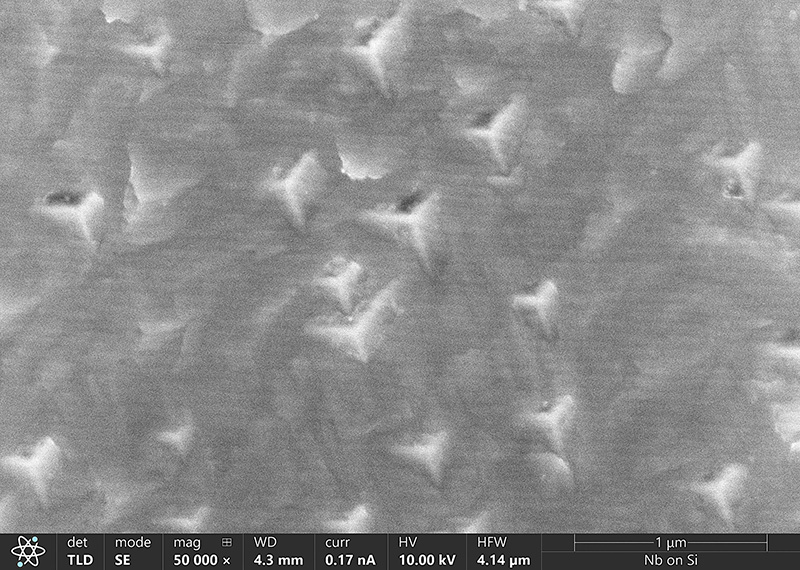
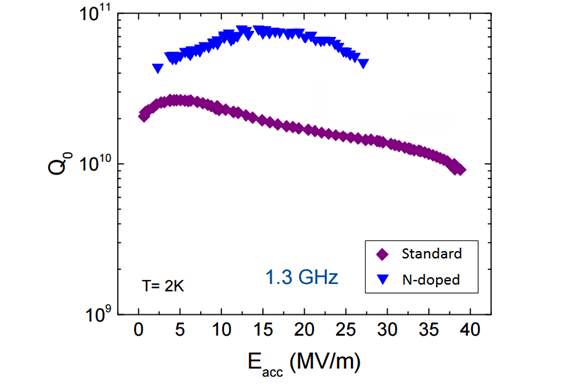
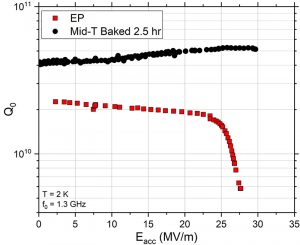
High quality factors (Q) are extremely important to accelerators with high duty factor, due to the infrastructure and operating costs of the cryogenic plant. In 2012, Fermilab discovered a process to achieve unprecedented Q values by treating them in a high-temperature furnace with a low-pressure nitrogen environment. Significant progress has occurred in the past years on nitrogen-doping processing development and in understanding the root of the improved performance, thanks to surface studies of the N-doped samples.
Following rapid development, the technology has been used in the LCLS-II accelerator and LCLS-II HE, which is an upgrade to LCLS-II, with the potential to cut the cryogenic losses of this machine by a factor of two. The nitrogen-doping method is also used for preparing high-beta, 650-megahertz, five-cell cavities for the PIP-II linac. Researchers are studying the underlying phenomena that lead to higher quality factors, both theoretically and experimentally. Work continues toward developing an optimal doping treatment to achieve high Q at even higher fields, greater than 25 megavolts per meter.
Mid-T baking
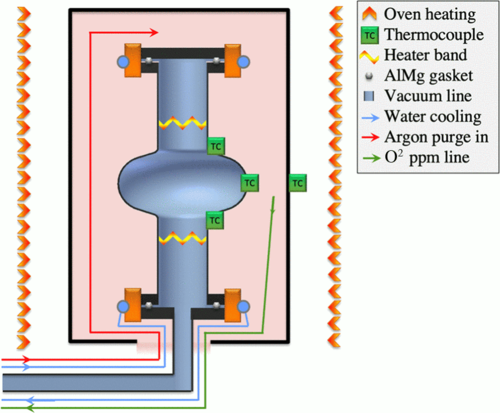
Fermilab also discovered an alternative process called medium temperature (mid-T) baking to increase the Q value of the cavity. Mid-T baking is usually performed at 300-350 °C in a vacuum environment to diffuse oxygen atoms in the cavity’s RF surface. The mid-T baking process has been chosen for application to low-beta 650-megahertz five-cell cavities for the PIP-II linac. Similar to the N-doping study, R&D on mid-T baking is ongoing with the aim of improving Q and the accelerating field.
Efficient Meissner Expulsion
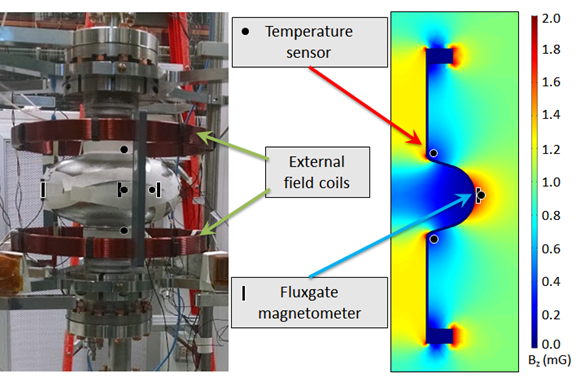
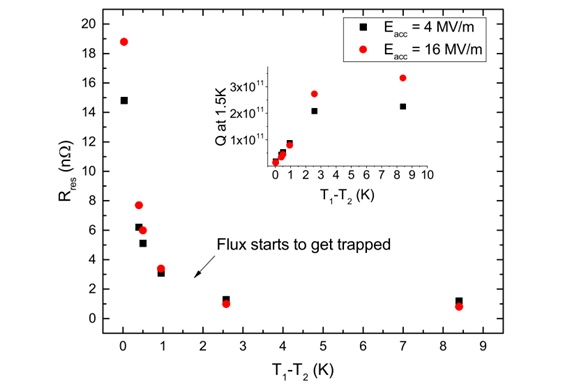
Ambient magnetic field present during the cooling of the cavities through superconducting transition temperature of niobium (9.25 kelvins) can be trapped and cause additional dissipation lowering the quality factor. Researchers at Fermilab found that the efficiency of the Meissner effect is determined by the thermal gradient at the superconducting-normal front during the transition. New cooling schemes and procedures have been developed to maximize the expulsion of the magnetic flux to maintain the ultra-high Q factors all the way through from vertical tests to cryomodule environment.
Nb3Sn-Coated Cavities
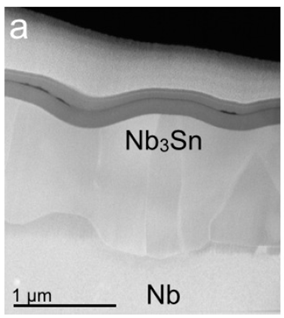
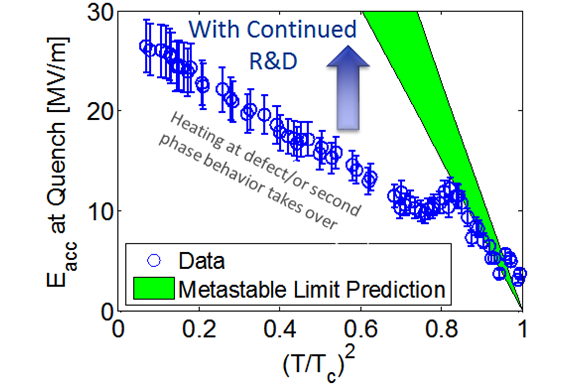
Traditional SRF cavities are made of niobium, and after many years of development, researchers have found preparation techniques that generate performances close to the fundamental limits of this superconductor. However, proposed next-generation particle accelerator applications are extremely demanding. Using current technology, they would require very large cryogenic plants and exceptionally long accelerator strings. The alternative superconductor Nb3Sn offers improved cryogenic efficiency (proven) and increased accelerating gradients (predicted).
Researchers at Fermilab are developing an apparatus to coat niobium cavities with this exciting alternative material. The coating chamber will be large enough to accommodate even production-style cavities. This technology has the potential to offer dramatic improvements for large-scale applications in high energy physics, nuclear physics, and basic energy sciences.
Because of their ability to operate at relatively high temperatures using a cryocooler instead of a cryogenic plant, Nb3Sn cavities can also have transformational impact on small-scale applications in hospital treatments, university research, border security and treatment of wastewater and flue gas.
Cavity Resonance Control
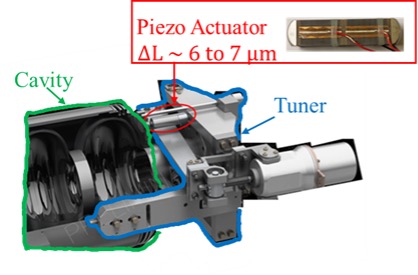
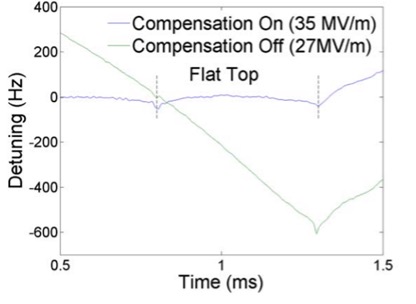
A resonance control (RC) algorithm implemented on a superconducting RF cavity can save millions annually in RF power costs by reducing power consumption and improving accelerator efficiency by preventing RF power trips. The accelerator environment experiences deterministic and stochastic vibrations that couple to the cavity, leading to detuning. State-of-the-art RC algorithms have shown the capability to compensate for and mitigate deterministic detuning vibrations. These algorithms have been developed at Fermilab and implemented at FAST, KEK for ILC, and LCLS-II. However, these algorithms don’t adapt well to stochastic vibrations, which can introduce additional instabilities and further detune the cavity. By addressing their limitations, machine learning techniques can enhance traditional RC algorithms, which are currently being explored.
Fundamental material investigations
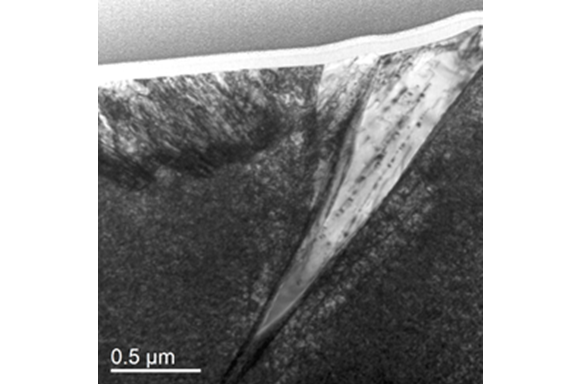
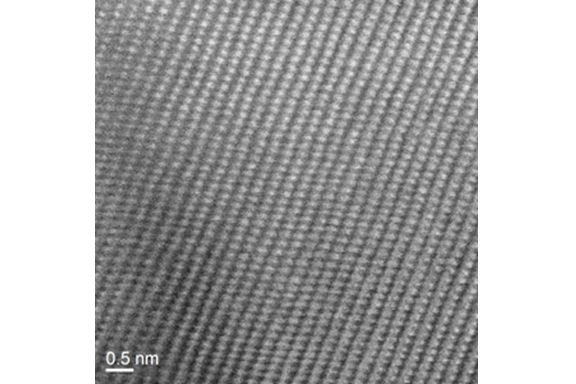
The growing demand for state-of-the-art SRF cavities requires a good understanding of the processes responsible for their performance limitations. In the absence of the external degrading factors, SRF cavity performance is fully defined by the quality of the superconducting material which can be tailored by the temperature and chemical treatments. The superconducting behavior of the cavity is mainly determined by a thin layer near its surface, defined by the magnetic field penetration depth. For instance, for traditional niobium, superconducting currents flow only within approximately the first 100 nanometers.
Investigation of material structure and composition on nanoscale requires a set of advanced material characterization tools. On-site characterization techniques include SEM, FIB, EDS, EBSD, SIMS, XPS, PPMS, optical laser confocal microscopy with the cooling stage, and sample polishing setups for the sample preparation.
Development of new SRF materials such as Nb3Sn, as well as surface modification by N-doping and mid-T baking, require extended material characterization. The combination of complimentary material characterization techniques, conducted either on-site or in other academic user facilities, provides insight into SRF performance-defining processes.
High-Gradient Niobium Cavities
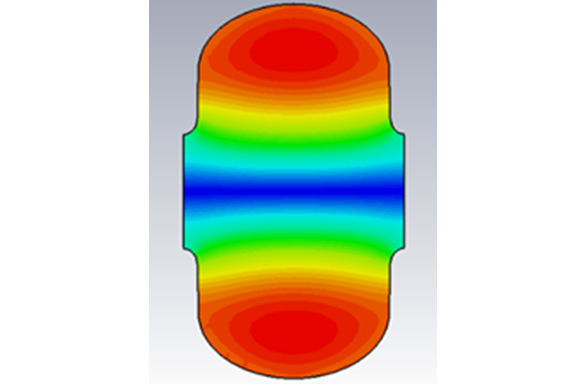
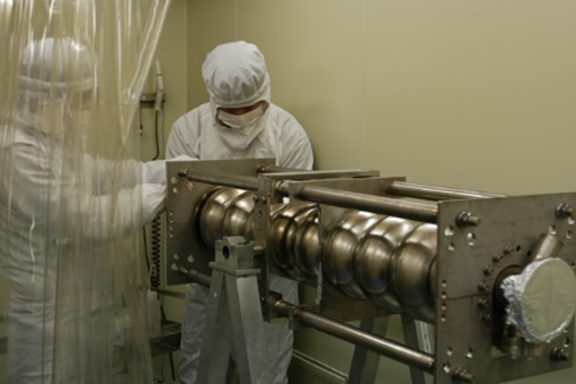
A high energy linear collider accelerates charged particles up to energies of hundreds of giga-electric-volts to tera-electric-volts. Superconducting RF cavities provide the best beam quality in a cost effective way that saves tremendous electric power consumption. Increasing the accelerating gradient in a SRF cavity to its maximum is highly beneficial to reduce the accelerator length and reduce the construction cost.
Fermilab is collaborating with the world leading SRF laboratories to advance niobium cavity technology to much higher usable gradient for future high energy accelerators. The development combines alternative cavity shapes and state of the art high quality factor processing technology.
Tunable Cavity R&D
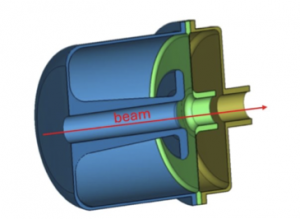
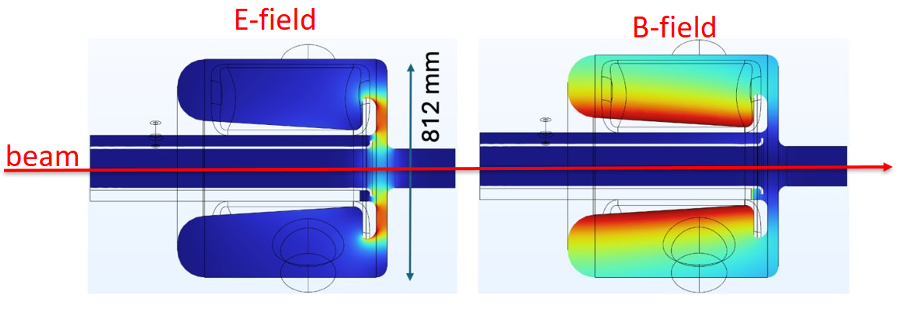
Rapid-cycling synchrotrons are critical components of many accelerator complexes in the United States and around the world supporting high-energy, nuclear and accelerator physics research. However, RCSs conspicuously remain SRF terra incognita: they are the only major component of the typical acceleration chain that has not yet made the jump to SRF cavity technology due to the wide frequency ranges and slew rates they require of their cavities. Fermilab is developing a program to deliver the millions of dollars in operational and construction cost-savings offered by SRF cavities to RCSs. This project is guided by the specific aim of delivering a tunable 53-megahertz SRF cavity suitable for demonstration in the Main Injector ring at Fermilab. Design and testing efforts are underway to explore novel tunable cavity geometries, tunability and tuning methods, and higher-order mode damping schemes.
Collaborators
The collaborators for the Superconducting RF R&D include: Fermilab, Cornell University, DESY-Germany, Facility for Rare Isotope Beams (FRIB), Jefferson Lab and KEK-Japan.