
Comprehensive magnet development and R&D capabilities
Fermilab’s expertise spans all areas of magnet and conductor research and development, focusing on evaluating and improving technologies for current and future accelerators, as well as the advancement of new superconducting and structural materials and components.
Fermilab’s Magnet Development Program leads the design, construction, testing and analysis of accelerator magnets and related components for Fermilab’s Accelerator Complex, and for accelerators worldwide. The program:
- Offers comprehensive services, from initial design and magnet assembly to field measurements, including testing at liquid helium temperatures.
- Provides essential support for major projects such as Hi-Lumi LHC, LCLS-II, Mu2e and PIP-II, and technical accelerator support.
- Plays a key role in training the next generation of physicists and engineers in magnet technology.
In addition to magnet development, Fermilab offers advanced testing and instrumentation services. These include measuring and testing R&D and production accelerator components, and developing advanced instrumentation, control solutions and cryo-mechanical systems for accelerator applications.
Learn more about the lab’s magnet development and its R&D capabilities in the following sections:
Magnet design | Magnet fabrication | Magnet testing | Conventional magnets
Superconducting Strand and Cable R&D Lab | Cable development and testing | Lab infrastructure and equipment
Magnet design
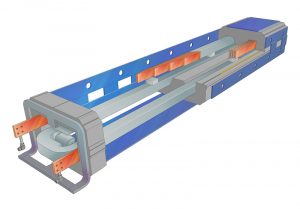
From design to extended simulation, the team uses state-of-the-art tools, years of expertise and innovative ideas to deliver high-performance magnets that meet challenging requirements. APS-TD also collaborates with domestic and international institutions to strengthen capabilities and create shared value.
Magnet fabrication
Fermilab has been at the forefront in superconducting magnet fabrication for particle accelerators for more than four decades, including early work on the Tevatron and contributions to major projects like the Superconducting Super Collider and the Large Hadron Collider.
The magnet team at Fermilab designs, builds and tests both superconducting and conventional magnets. These magnets are essential for steering and focusing particle beams in accelerators. The team supports the Fermilab Accelerator Complex by maintaining and upgrading existing magnets and developing new ones to improve performance.
Fermilab’s in-house capabilities include:
- Developing and testing superconducting materials and cables
- Fabricating customized superconducting magnets, including compact or irregularly shaped coils
- Producing and testing small batches of specialized superconducting cables
- Building conventional magnets in both small and large quantities
- Repairing and refurbishing older magnet components to extend their operational life
Magnet testing
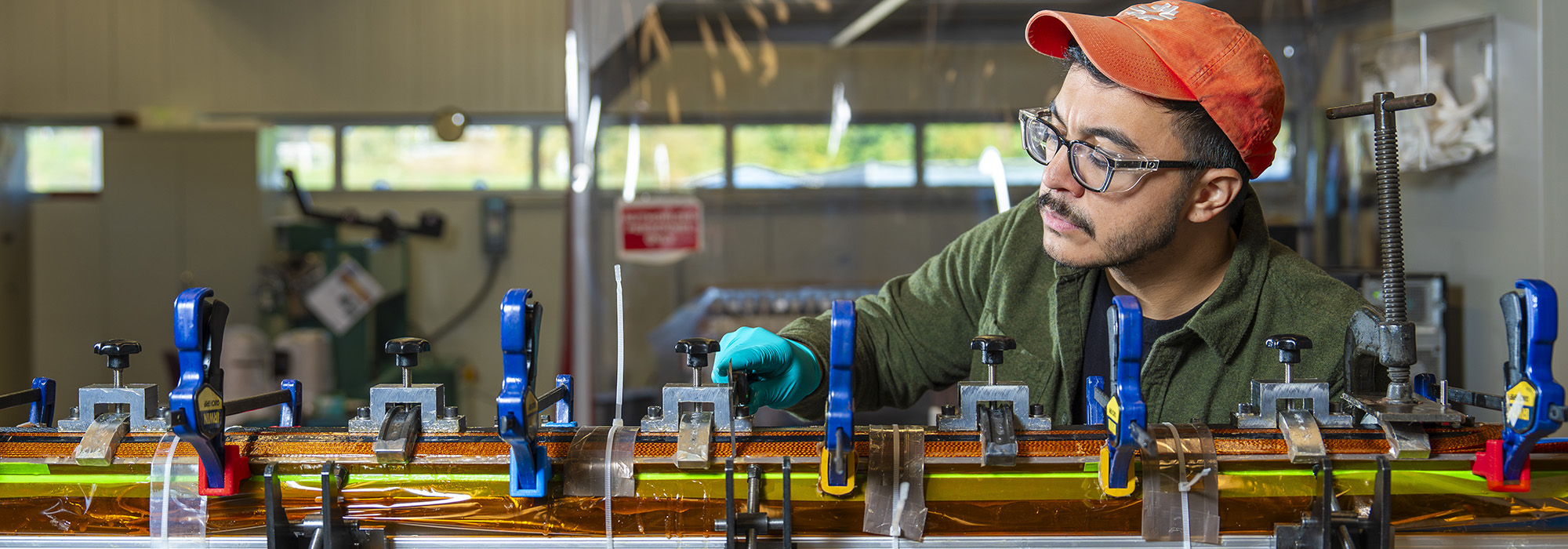
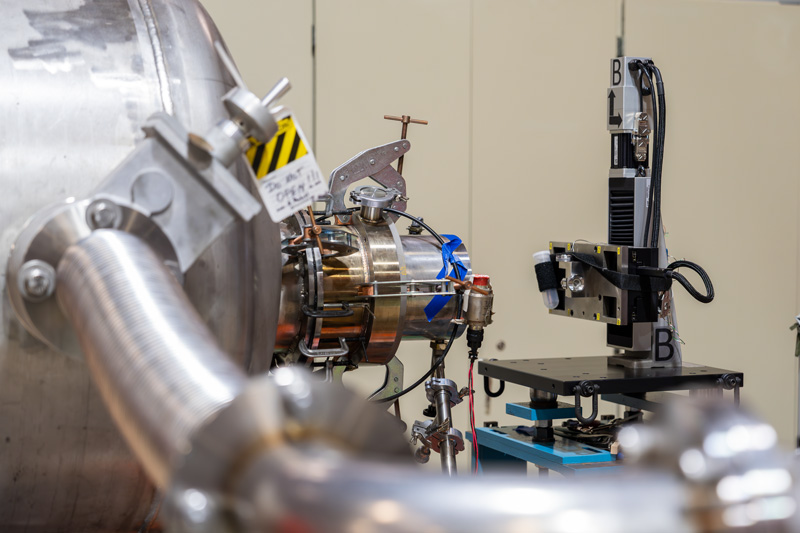
Before leaving Fermilab, every magnet undergoes comprehensive performance and field quality testing to ensure it meets the highest standards. This rigorous evaluation process ensures that magnets operate efficiently and reliably, whether they are used in superconducting or conventional applications.
Fermilab uses advanced test stands to measure key magnet properties, including magnetic field strength, power consumption, heating and quench performance. Some of the primary testing capabilities include:
- Measuring and analyzing complex magnetic fields
- Evaluating power consumption and heating in conventional magnets
- Studying the quench performance of superconducting magnets which is the process where a magnet temporarily loses its superconducting state
- Testing splice resistance and other properties critical to magnet performance
This thorough testing ensures that each magnet is ready for its role in cutting-edge accelerator projects, where performance and reliability are essential.
Key measurement tools include, rotating coil systems, stretch wire systems, calibration magnets, and hall and NMR probes.
Additional test measure factors include, how magnets respond to changes in temperature and current, inductance and energy loss, as well as magnet quench protection.
Conventional magnets
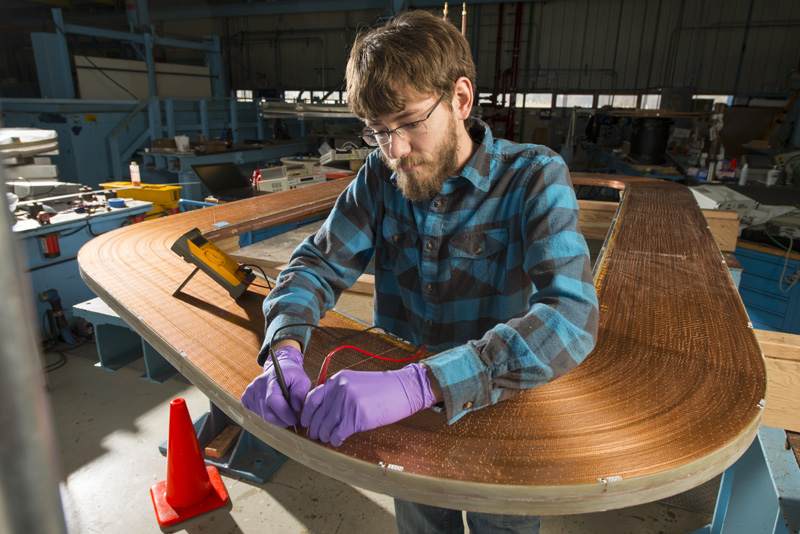
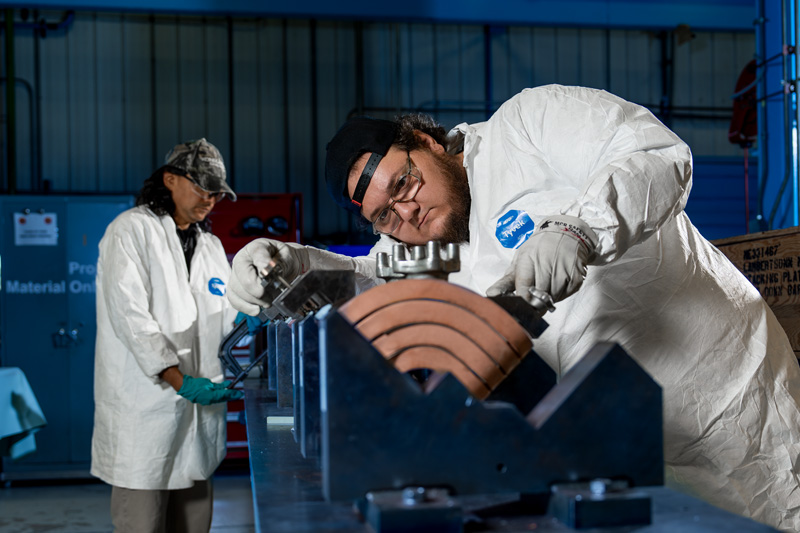
APS-TD has the capability to design, manufacture and measure a wide range of conventional accelerator magnets. This work requires diverse expertise, as designs range from extraction or injection kickers, Lambertsons, and strong bending dipoles to focusing quadrupoles and compact, multi-element corrector magnets.
The team also designs and fabricates fast-ramping AC magnets and gradient-field magnets for specific accelerator applications.
Superconducting Strand and Cable R&D Lab
Fermilab’s Superconducting Strand and Cable R&D Lab is a world-class facility dedicated to developing and testing materials used in next-generation particle accelerators.
Researchers at the lab study superconducting materials, which carry electricity without resistance, to improve the performance and reliability of accelerator magnets. This work includes evaluating how materials behave under extreme conditions such as very low temperatures, high magnetic fields and mechanical stresses.
Key capabilities of the lab include:
- Measuring the performance of superconducting tapes and cables in environments ranging from near absolute zero to 80 K and in strong magnetic fields
- Testing mechanical properties, including flexibility, durability, and resistance to bending and compression
- Designing and developing specialized superconducting cables used to power accelerator magnets
Since inception, the lab has also served as a training ground for more than 30 graduate students in physics and engineering, offering hands-on experience in superconductivity, cryogenics, electronics, materials science and more.
Cable development and testing
Cable development at Fermilab involves designing and fabricating custom superconducting cables to study how different geometries, materials and manufacturing processes affect performance. Advanced tools and modeling techniques are used to:
- Fabricate high-performance cable prototypes
- Analyze cable behavior under mechanical stress
- Test electrical properties and structural characteristics
This work helps improve the design and durability of cables used in accelerator magnets around the world.
Lab infrastructure and equipment
The lab is equipped with specialized cryogenic systems capable of simulating the extreme environments found in particle accelerators. These systems support a range of research activities, including performance testing, thermal analysis and structural evaluation.
Additional equipment includes:
- Powerful magnet cryostats for testing at low temperatures and high magnetic fields
- Furnaces for heat treatment of superconducting materials
- Tools for shaping, deforming and measuring cables and wires with high precision
This robust infrastructure supports not only R&D in superconducting materials but also key contributions to major international accelerator projects, such as Muon g-2, Hi-Lumi LHC and PIP-II.